Monday, March 07, 2011

Art Yarn, Revisited

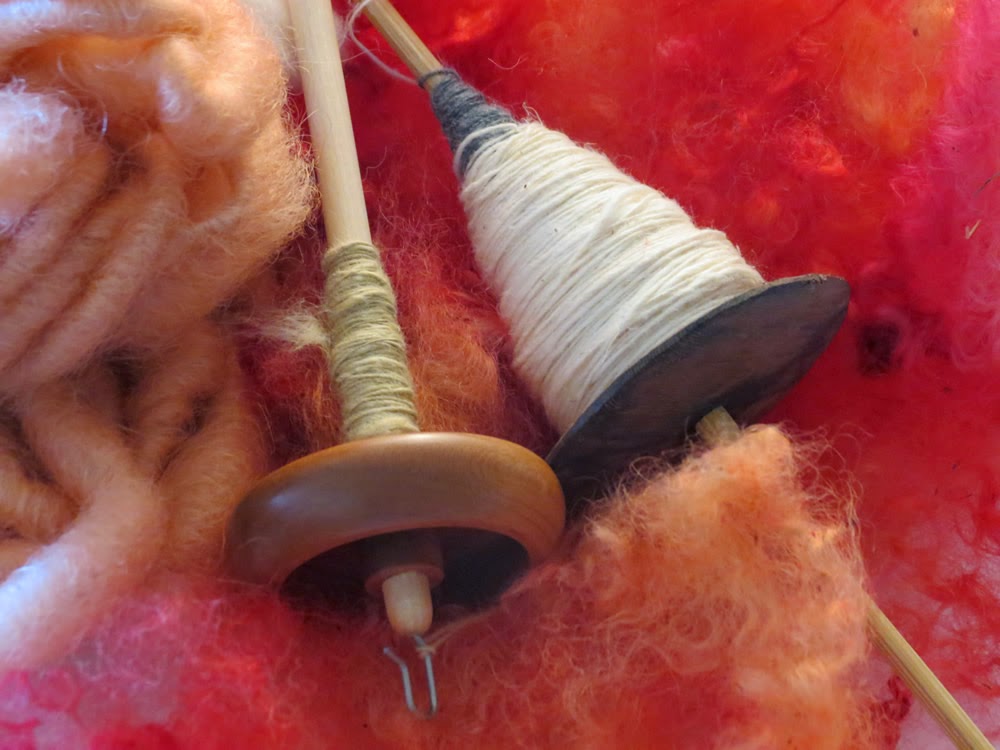
The question of the week seems to be, "Can one make art yarn with spindles?" My response takes up more than a couple of sentences, so I'm posting here where I can wander a bit.


If you want a simple answer, that answer is yes. You can leave now to continue your stumbling in the dark. If you'd like to explore a bit deeper, read on and/or continue searching within yourself for the aspects of you that generated the question.

Here's a way that I start to think about the question...

First - if you are wondering if something can be done, why isn't your response to simply try and then observe the results. If you have asked a question, doesn't it seem that there is desire to know/explore an area? If you asked the question in a public forum and people responded, no it can't be done, would you not bother to try? Why would you accept someone else's answers?

In an area such as spinning, it's not like there are huge mistakes that can be made (these days.) No one will die if you try to spin a yarn and it doesn't work out the way you envisioned. You don't have to make a huge financial investment to try spinning what you're thinking about. You invest your time and then you know whether it can be done by you (at this time) or if you need more knowledge and/or need to find a teacher.

My second thought is - do you know what you are actually asking about? "Can one make art yarn with spindles?" What does the term "art yarn" mean to you? How do you define the term? I ask, because I have never seen a definition that satisfies me, that differentiates "yarn" and "art yarn" in any meaningful way. (I have written about this topic before.) Is there a reason for making these distinctions? For me there isn't. Often, calling one's yarn an "art yarn" seems to be done to cater to those who have a superficial understanding of creating/spinning in the hopes of making more money from the product and/or purporting to have a level of experience that one might not actually have.

I would say that I can make all kinds of yarns on spindles and wheels and I also teach others to do so. Candace Crockett, Mabel Ross and Diane Varney have all written excellent books on spinning and have shown techniques for manipulating fibers in creative ways. One can adapt these techniques for use with spindles and wheels.

These techniques are kind of a paint by number approach. After learning technique - what to do with your hands and what to do with the fibers and tools - what's next? Maybe one continues to refine technique, seeing how these techniques play out using different fibers, creating different weight yarns. This, in itself, could occupy a lifetime's worth of fun and experimenting. There are so many variations on types of yarn that can be created that one could be amused forever.

Depending on personality, needs, desires, technique explorations might be enough for an individual. For others, maybe one starts to be entranced by a different aspect - the expressive potential of spun fibers, an exploration of the extremes - how far can one push a technique or quality? Maybe beauty, ugliness, the embodying of the sensual play a role in developing one's yarns. Maybe portraying that which is beyond words is attractive to an individual. (And much much more...)

If one is attracted to any of the aspects mentioned in the previous paragraph, there are ways of interacting with them. One can look outside to what others have done. Why anyone would emulate or try to copy other peoples expressions is beyond me. Each of us has our own song, and singing anothers song, appropriating their work, can lead one away from one's self. If one wants to live on the surface of life and/or is happy to try to live someone else's life other than her/his own, maybe it will be a sufficient amusement.

Another way is to create from one's deep self, from one's experience of being on the Earth in this, our individual body in this time/space. That goes far beyond technique, and is an interaction that can tap into the most sacred of spaces, into all that humanity has explored and is currently exploring - experiences that fuel our most important human stories, our interactions with all the spirits of the Earth and our souls. One can learn so much by creating in this way, by allowing experiences to manifest themselves in spun fiber, to allow this fiber to be a holder of knowledge and energy.

Can the above be taught? I think that if that is the way one lives one's life, seeing each task and day as potentially sacred, the yarns that one creates will be a reflection of this. A teacher can help you to access these places in yourself, can point out some things that you might not have noticed and the possible significance for you.

Labels: , ,

Thursday, November 11, 2010

shifting sands!

i've moved - i live in a place where there's sand, not dirt, more water than land. the winds are relentless, the smells, sounds and visuals offer me so much beauty and inspiration - i hope i never forget to be grateful for all that i'm able to experience here in manomet. i'll post some photos of my travels/walks here while i continue to talk about spinning and art over here :)

Wednesday, August 25, 2010

Extend the Summer - Get to Maine + Fiber College!

That's the way it seems to me when I go to the classes and wander the grounds of Fiber College - hanging out at the ocean, spinning outside with others, enjoying a camp style dinner with lots of people who've been busy learning and playing with fibers all day.

I'm teaching "Spinning Silk on Spindles" and another workshop on Nature as Fiber Inspiration - "The Textility of Fiber College". These are both early morning classes - the silk class is on Saturday, 9.11.10 and the nature + fiber class is taught on Sunday, 9.12.10. Plenty of other classes to attend or just go kayaking, walk the grounds, talk to the people offering goodies for sale.


The nature and fiber workshop came about because I wanted to more consciously observe the environment when at Fiber College. Because there is so much to do, it was often a blur when I went home - I found that when I slowed down, took some mental/sensory notes, I had even more to nurture my creativity later in the year.

So treat yourself - if you're anywhere in New England or can get there from where you are, go. You will have a storehouse of knowledge and experience to interest you through the winter!

Labels: , , ,

Monday, June 07, 2010

So what's with the term "Art Yarn"?

Art Yarns/Slightly edited from a talk I was asked to give to a spinning guild a couple of years ago.

OK, so what is “art yarn”? As I mentioned earlier, I think it’s a loaded phrase. I don’t generally use the term. I don't really see the point of these categories and pigeon holes in life or yarn.

There doesn’t seem to be a consensus among spinners of the definition. Many who spin say they "know them when they see them.” What they are NOT, though, is beginner yarns or mistake yarns, (although I think beginners can also make boundary expanding yarn.)

The “Art Yarn” term has been used in a few different ways.

1. To describe yarn that didn’t turn out the way one expected—“mistake yarn”. It’s sometimes used to make newer spinners feel good about their yarn. Often, people seem to imply that those making some of the wilder yarns don’t have the skills to make “traditional” yarns, which is usually not the case.


2. Yarn that incorporates a lot of doodads, "less traditional" materials—sometimes it’s implied by critics that the yarn is less good, because, in their eyes, it can’t be used. Of course, people do use it for any number of things. Sometimes, these yarns require a very creative approach to working with them. If one knows only how to follow patterns, it might be a challenge to imagine how to use them. (A number of books exist that show you how to create with a pattern free/yarn specific approach.)

Here’s how I would distinguish the term—it’s yarn that is created intentionally, with a knowledge of what fibers can do and the desire to expand the visual, tactile, and sculptural capacities of yarn. It’s yarn that comes from life experience and is transformed into a physical form. It can be pure art, to exist on its own and/or can be transformed again by someone who uses it to weave, knit, crochet, net with—the possibilities are endless. (And I think it's also often created in a "no intention"/play state of mind.)

As far as I can tell, there’s always been yarn that expanded upon the possibilities of a simple single. Maybe the first “art yarn” was born when some Neolithic spinner saw a slub in her yarn and said, “Screw it—I like it!”. There are beautiful examples of inventiveness from the Incas. They incorporated feathers into their yarns and designed some yarns so that certain decorative effects would occur when they were plaited. In earlier times, there was much greater variety of yarn created than is created in current times. Weavers demanded them!

A number of spinning books from the the 70’s in the U.S. show examples of experimental yarns, addressing the idea that spinning for any length of time would lead one to ask “what if…"? So, in some ways, these yarns that are perceived as less traditional could be seen as belonging to a long tradition.

Many online fora allow opportunities for creating variety in yarns. Over the past 7 - 8 years, you’d have been able to find a lot of experimenting in the following: Live Journal—Fiber Friday community, Crafster forums, The Yarn Museum, Etsy forums and lately, Ravelry. A number of these groups use themes and games to encourage play. Some take off points have been creatures from popular culture, people and cultures from the past, books. So the idea would be to spin your version of Dr. Seuss, your secret crush, the word “celestial”, the idea of a shipwreck, Madonna, Africa...

My personal themes and inspirations have been things like imaginary creatures, spirituality, and films. Sometimes I’ve just wanted to express joy or anger, make a yarn portrait of one of my cats or I’m attracted to a certain fiber and want to see what will happen to it if I spin it in a new way.


Some sources for inspiring materials: fiber festivals, online retailers, thrift shops, antique shows, button and fabric shops.

Some techniques to play with: plying, wrapping, coils, boucle, adding beads, combining materials, multiple plies, corespinning, made up/in the moment techniques.

Some sources to work off of: colors (they can provoke such emotional responses), personal interests, landscape, anything that engages ANY of your senses. What is experimental and inspiring to YOU? Working with different fibers, trying a new technique, portray something in a yarn...

Considerations: it might be helpful to NOT think of the use to which a yarn will be put, maybe think less about the structural integrity of a yarn while in experimental phase. Keep an open mind and create with a sense of play.

Capacities of wheels—orifices and hooks can be considerations. But you can be plenty experimental on any wheel! You might have to be a bit more patient to deal with hooks. Spindles have fewer limitations as far as orifice and hooks. Work within your own wheel’s capacity to experiment. Yarns needn’t be spun, but can be created in many other ways.

Finishing yarns: I like to make yarns that will withstand most uses I’ll put them to. I skein, wash and store them as any other yarn I make.

My hope is that we can allow all kinds of yarns to be and that we can appreciate them for whatever qualities they have. And we can appreciate the makers of all the various kinds of yarn, too!

Originally given as talk to spinners who were curious about "art yarns". Posting this now because of some recent discussions with other spinners~

Labels: , , , ,

Friday, June 04, 2010

not machine readable


Meg initiated a project where we'd pick out some pictures, send them to another and then they'd weave something in response.

Rose in NZ sent me pictures of some scenes from her country, a barcode image and a menu card with foods listed by color. I must tell you that my initial reaction was to want to tear up the pictures. The barcode made me particularly furious. It reminded me of so many dull weaving shows I've been to that make me say to myself - why are these people doing this???

Weaving is so alive and yet there is such a staid aspect to so much of what's shown. So technically competent and yet so stuck in the mud. There, I've said it. Apologies to so many who continue to explore and innovate.

I was intrigued by the photo of nubbly gray rocks (?) - I was reminded of a yarn that I had around. (It's from Italy.) I still wanted to tear up the barcode, symbol of standardization and capitulation to the bottom line. Oh good, as usual, my anger was fueling my creativity :)

So anyway, frame loom, some handspun yarn from what's left in the drum carder (shown on spindle, at top), some Habu yarns, stripey ribbon - all just a bit off center. Shown in lots of orientations, cuz I like to mix it up. Windows to let light in. Added another piece at an end, woven free loom style. I see the photos reflected, I see my responses. Glad to have been able to consider all that I did while in process of working with it.

I sometimes surprise myself with the strong feelings I have about textiles, weaving, spinning. When I've been in an environment or with people who are open minded and expansive, I am happy that creativity will continue to flourish. When I run into people who forcefully assert that there is one way to do things, try to limit creativity and expression, try to exercise their power to have weaving/textile shows reflect their outlook, well, then I just want to shake free of all that...


Well, humor usually helps lighten my mood if I start to get too serious about an issue - start taking it too personally. So in that vein, I like this artist's (Scott Blake) take on the barcode - you can generate one for your own self here.
A long time ago, when I was slumming in the illustration/design world, a few people finally realized that even barcodes didn't have to be "standard". Some are here and here. But make no mistake, they're still barcodes - I am not fooled by their fluffy personality.

OK, I think I will go smash a loom now :)

Thanks, Rose and Meg.
::Saying a silent prayer that the formatting on this post even slightly resembles what I'm looking at before it's posted::

ETA: giving up on trying to make this look good for now.

Labels: , , , , ,

Monday, April 05, 2010

Spinning Classes + more

A few classes that I'm teaching. (grrr...my website can't be updated at the moment, so I'm telling you here).

Art on a Stick/Art Yarns
(For beginners and advanced - you'll learn to spin yarn and this class will have an experimental focus/outlook. You can keep it simple or get as crazy as you want.)
Learn to spin funky, artful yarns on a spindle. Start with spindle basics, then explore different fibers and how they can be used to create offbeat yarns. If you have tried spindles before, try them again in a playful environment with an artist who has created yarns of every imaginable type.
Sunday, 1–5pm, April 11, 2010 (at The Eliot School, Boston, MA)
Register here
Note: Please register by 3PM, Friday April 9.
The Eliot School doesn't handle registrations after that point. If you want to register after that time, either email me (lindaATstoneleafmoon.com) or just show up, prepared to pay for class (cash or money order).

Crazy Quilts
For ages, people have combined leftover fabrics into crazy quilts, making beautiful assemblages embellished with embroidery. In this workshop, you will complete either a ten-inch square that you can incorporate into a larger quilt at home or a small child-size quilt.
(taught at The Eliot School, Boston, MA)
2 Sundays, 1–5pm, April 25 & May 2, 2010
Register here

9.11.10 Spinning Silk On Spindles
open to beginners and advanced
9.12.10 The Textility of The Fiber College Environs
Details on the above classes soon - they will be held at Fiber College in Maine, USA

Labels: , , , , , ,

Thursday, January 21, 2010

The Milkweed Project

Shan Bryan-Hanson conceived The Milkweed Project. She wrote, "The Milkweed Project is a collaborative art project that will culminate in a giant art installation that will create, for visitors, the feeling of being inside a Milkweed Pod (as I imagine it to be)."

She opened it to those who wanted to knit/crochet elements of the work. She will gather the elements and make an installation. From Shan's site: "...The project also explores our interdependence with nature. Milkweed pods are a small but important part of the ecosystem. They spread because of the light nature of their seeds, which are carried by the wind. By using the internet as the wind, and each participant as a new plant, this project attempts to mimic that process. " I was most intrigued by her idea of using the internet as wind. I like the thoughtform of bending technology and shaping it into a new natural element.

I played with the idea a bit over the summer, and asked one of my classes at Fiber College to consider creating work to submit. I hope they did! (ETA: I see that one of my class participants, Jackie Fee, did send in work. Well done!)

I will look forward to Shan's gathering and coordinating the work of many to create a new vision for all of these elements - all these explorations by individuals who took time out of their lives to consider how shades of white could be bent/stitched into shapes that were open, closed, tight, loose, straight, curved, hard, soft...enjoy the pieces by other participants here.


Labels: , ,

Powered by Blogger